Language Arts is probably the single subject that I spend the most time worrying over. It is the one subject area where each child has shown themselves to learn differently than their siblings. It is also the subject that I have found that the right fit in curriculum can make a difference in success or just getting by (or not getting it at all). We have found that resources from Memoria Press have been a great fit in our homeschool. The only question was, would the new Traditional Spelling II curriculum be a fit for my children?
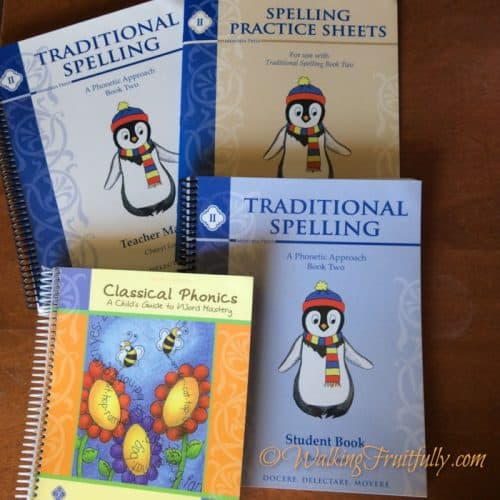
In the past, we have addressed spelling as part of an all-encompassing language arts curriculum. This is the first time to do spelling only with the youngest two of our learners. I was not sure until receiving our materials which child this would fit best, our second grader (who is doing first grade reading) or our fourth grader (who is somewhere in the second-third grade level in reading). Consistent with our experience with Memoria Press materials, the upper end of their recommended age is where this fits for us. Because this is the second volume of Traditional Spelling, once the first is completed, your learner can move right into the second one. For our 4th grade daughter, I feel comfortable skipping that first level. Her younger brother however, will be using the first level before utilizing this second level.
It took us a couple of weeks to really feel comfortable with the flow of the lesson. There are five days of work for each lesson, taking a typical week. We do school four days a week, but have been doing spelling on Thursdays (our usual day off school for errands). By far the longest day for each lesson is Monday (Day One). Even though each page in the student book is for one day, in the teacher’s manual, Day One is the better part of two pages. This was a bit overwhelming at first. There is a lot of useful information that is covered here. Not only is the phonics focus of the week introduced, all of the needed Phonics Flashcards and related pages in Classical Phonics are covered. These resources are not optional but are essential (and one of my favorite aspects of this curriculum). If you use the first level prior to the second level, you will already have these. Any advanced prep is also listed with the first day, though you will want to do it ahead of time. This day of the lesson is already going to be lengthier than the other days, so have as much ready ahead of time as you can. Trust me!

On Day One, not only are each of the fifteen words introduced, spelled, and defined, but some study of the words is done as well. The words are written by the student, grouped by different characteristics. This could be by vowel team, consonant team, or sight words. There have been 2 or 3 sight words each week, though in future lessons there are not any. We have also seen an occasional review of a word from the first level. Covering each word in this introductory lesson does take time, but is essential to the other days going smoothly.
We did not utilize sentence strips. These are a great resource for classroom use, but I don’t feel they are necessary when working with only one or two learners. I do write each word on index cards, using color as recommended. This is the same idea of using the sentence strips but keeps it more in scale with our homeschool – both the ease of obtaining index cards and the size of them. My other favorite aspect of this curriculum is the use of color. On the second day of the lesson, each word gets color applied. Utilizing the same color scheme throughout all resources helps to highlight and reinforce. The Day Two sheet also has each word written again. As the lessons progress, this may have the student looking at syllables, plurals, suffixes or unscrambling. This day seems to be the easiest for both my daughter and I. We are doing something fun with the writing of the words. As we work with the words, my daughter follows the same pattern for each word – saying it, spelling it, then saying it again. This method is another proven method for aiding retention (and the format used for spelling bees as my daughter pointed out). Even if your child has a dominant learning style, utilizing a multi-sensory approach has better results than only hitting that one style.

Day Three begins with a story that incorporates each of the spelling words. The spelling words are in bold. The directions in the teacher manual are great for classroom use, and easy to tweak for one-on-one use. My daughter and I would take turns reading each sentence (or I would read while she followed and she read the spelling words as we came to them). Sentences followed that needed the appropriate (spelling) word filled in on the blank. A bank of the spelling words made this a seemingly easy task. Even if it seems easy, this further exposure and in-context use of the words goes a long way toward long-term retention of the spelling words.
For the first three days there are often additional activities. These are quick, easy, and fun. I think we were supposed to do these before completing the sheet for the day, but we most often did it after. We usually did these at the whiteboard in the kitchen – when we needed to do any writing. My daughter is learning that it can be fun to “play” with words. We’ve made up riddles, thought of rhymes, and more.
Day Four is dictation. Before beginning with the spelling words, the sounds addressed for this week’s lesson are done first. Next, a sentence including the spelling word is read. I am grateful for these sentences being done for me. It’s not always easy to come up with sentences as the activities have shown me. Only the spelling word is to be written. Once each word has been written, a sentence is read that is to be written in its entirety. Day Five is “the test” and will feel much like the previous day. Only the word’s sentences and the lesson sentence are done. The sentences are again provided and are different than the ones used the day before.
Even though each day’s work is listed as Day One, Day Two, etc. I really think this works best to cover a part each day, a full lesson each week, beginning with Monday. Early in our use of Traditional Spelling II we tried to utilize this only three days a week. The weekend was just too long in between to make it easy. We found it easier to just review already covered words if we found ourselves with less than a full week to work with. Now that we’ve found a good rhythm, we’ll be continuing to use this. We really enjoy this spelling curriculum and have seen improvements across other areas, too. Reading and writing are becoming easier for her – yay!
Other Crew families received Latin or Music Appreciation resources in addition to the Traditional Spelling that we reviewed. Don’t miss those reviews! The Music Appreciation is on my list to add to our resources for Morning Time. Which Memoria Press resource do you hope to add to your plans? Click the image below to read the reviews from this Homeschool Review Crew run.

