


When we use and hear the term argue, we are usually thinking of this definition (from Merriam-Webster.com) 2: to contend or disagree in words. The intended meaning for the purposes of this curriculum (and this review) is to reason; to debate or discuss (found on www.1828-dictionary.com). The definition of the verb reason as found on that same site of the Noah Webster’s 1828 dictionary is to find by logical processes. This way of arguing I definitely want my children to know.
The Art of Argument is the beginning level of a series from Classical Academic Press on logic. The Art of Argument covers informal logic through learning about informal fallacies. The others in the series are The Argument Builder which focuses on building arguments (aptly named) and is a blend of logic and rhetoric. The third in the series is The Discovery of Deduction. This is a course in formal logic for junior high age students. There is some helpful information in the catalog about the whys of formally studying logic and how these material from Classical Academic Press fit. There is also a handy FAQ from their website.
Most of us use reasoning and logic to some extent daily. When we encounter (are bombarded with?) advertising we automatically go through thought processes determining relevancy and believability. For some of us, this comes easy. For others, we often get pulled (often emotionally) towards the poorer choice. I never learned logic formally. I am often one of those “led astray” by emotional appeals. I don’t want any of my children to be taken advantage of or led astray. With all of the political ads around at this time, it is even easier to find the real-life examples of fallacies. We read – a lot. Not everything we read comes from our worldview. The information presented may be something very needed and useful, but we need to discern what to keep what to “throw out”. Our children need to learn this.
You may think–especially if you do not follow classical education in your homeschool–that this is not something you need to focus on. For some families, this may be true. This is not an area I want to take chances that it will be “caught” even if it is not taught. We take that approach with some things for our younger children, but logic and the ability to reason–and reason well, should not be one of them.
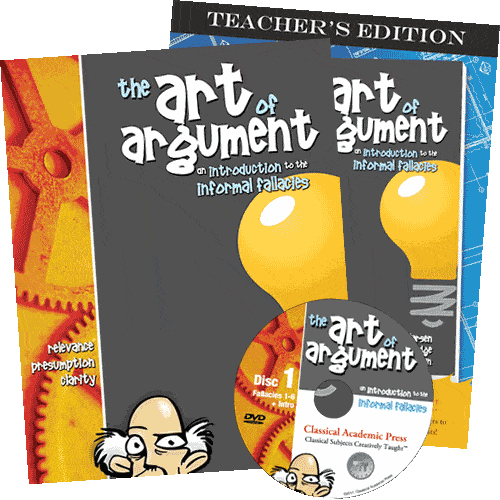
We (my husband, my eldest daughter and I) are enjoying these lessons. We are doing them together (I need it!) and my husband is enjoying this opportunity to be our instructor. We were given the student book ($21.95), Teacher’s Edition ($24.95)and a sample of the DVD series for the review. The teacher’s edition is not completely necessary — if you don’t need the answers. 😉 There are also some additional quizzes, etc in the TE. The DVD series ($54.95) covers the entire book in 8+ hours on 5 discs. A bundle of all three of these items is available for $88.95
This DVD set has many uses. The videos are broken down by the fallacies covered in the text. It features students and instructors sitting around a table discussing each fallacy. I have used it to watch before talking with my daughter because of my lack of knowledge in this area. We have then watched it together to facilitate our own discussion. If you will be doing this course with someone experienced in logic instruction and in a co-op type setting (more than 1 or 2 students) then videos may not be necessary. But for our family — even with our awesome teacher taking over 😉 we are purchasing the whole series. If you know my husband, he doesn’t like parting with his hard earned money, so you know it is really good.

My daughter is at the young end for this. She is not struggling with it, but we are going slow. The recommended pace is to complete this volume in a semester, a year for younger students. We will probably go a bit slower–at least at first. The lessons are presented in a fun way. The made up ads to illustrate the fallacies are engaging and effective. The slow down for us is the deliberate thinking we have to do (What, we don’t normally think?). We are getting so much out of this, the slower pace is not reason enough for us to set it aside and resume in a year or so. We feel this sort of learning is too important and needed for application in other subject areas to put it off.
The target age for this curriculum is stated as middle school or junior high. In our area, some schools have 5th-8th grades together as a middle school. Other school districts keep 5th and 6th grades with elementary and call 7th & 8th grades junior high. We don’t label grades strictly by age; nor do we keep to one grade for all areas of learning. All this to say, use your judgement for when you feel your child is ready for a course of this type. There are samples on the website to help you decide when your child is ready.
Some Crew members received Argument Builder. To read reviews of either product from Classical Academic Press, check out this post on the Crew blog.