
Art has always been one of my favorite subjects, so I am thrilled that my children love it as well. We have always enjoyed sketching, coloring, painting and creating. What hasn’t worked out so well is art instruction. Now, I fully believe that expressing creativity is not something that needs to follow some formula. There are however techniques and elements that can be learned and used as tools in being creative. Having the knowledge and skills doesn’t always translate into teaching someone else the same.
I am so very blessed by ARTistic Pursuits. They not only handle the instruction and skill building, but they bring in art appreciation, too. My eldest daughter (12 years old) and I have been going through the lessons from The Elements of Art and Composition – Middle School (grades 6-8) Book One ($47.95). Well, the plan was that I get to play, too. She, however, has taken off without me. I’m only a little sad about it.
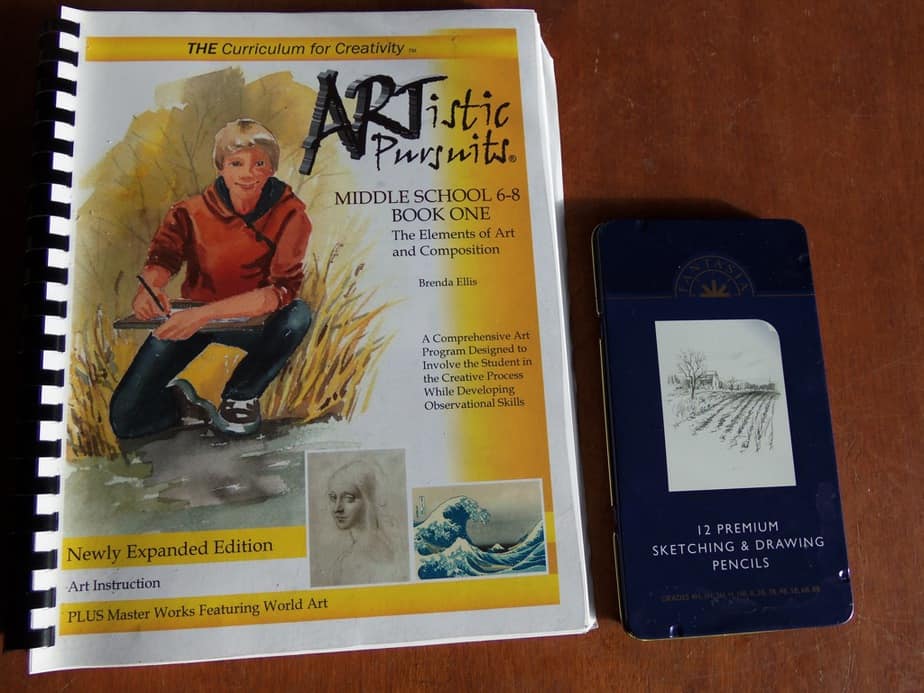
The only supplies she has needed thus far are the book, a good set of drawing pencils (a range of weights/hardness) and regular copy paper. She has also made use of our sandpaper block, good pencil sharpener and vinyl eraser. For some of her final drawings of a unit she is using the better paper from a drawing pad. To protect her work, we have started putting the drawings in page protectors in a binder. Little brothers like to add their own touch if given a chance (much to their big sister’s disappointment).
There are 16 units in the book each with four lessons. The first lesson is an introduction to an element – the vocabulary and a quick exercise in observation and creativity. I really appreciate this introduction and connection to something familiar. The first unit starts with their name – it doesn’t get more familiar than that! The second unit suggests something from nature.

The second lesson brings in art appreciation and history. This is when the student is exposed to both known works of art (well-known and lesser known) and some of the history surrounding art in general or the specific artist or the culture represented. I am especially fond of the world-wide aspect of this. There are many examples from Asian art that we are not exposed to as readily as European art (though there are examples from European artists as well).

The third lesson is on techniques. In this lesson the student uses the technique just learned to make their own work of art. In all the lessons we have looked at, the student is encouraged to draw what they wish. There is not a required subject as there might be in some of the other lessons. My daughter (and I) love this freedom. It lets her stretch a bit in trying new techniques, but keep the familiarity of favorite subjects.

The fourth and final lesson of each unit is application. This is the drawing for which my daughter often chooses the “real drawing paper”. In the unit we recently completed on line, my daughter was encouraged to not worry about mistakes. This is the lesson in which she first experimented with the different weights/hardness of pencils. By using the lighter weight lines (harder pencils) for the beginning of her drawing, she could easily adjust and correct mistakes. The more complete the drawing, the heavier the lines.
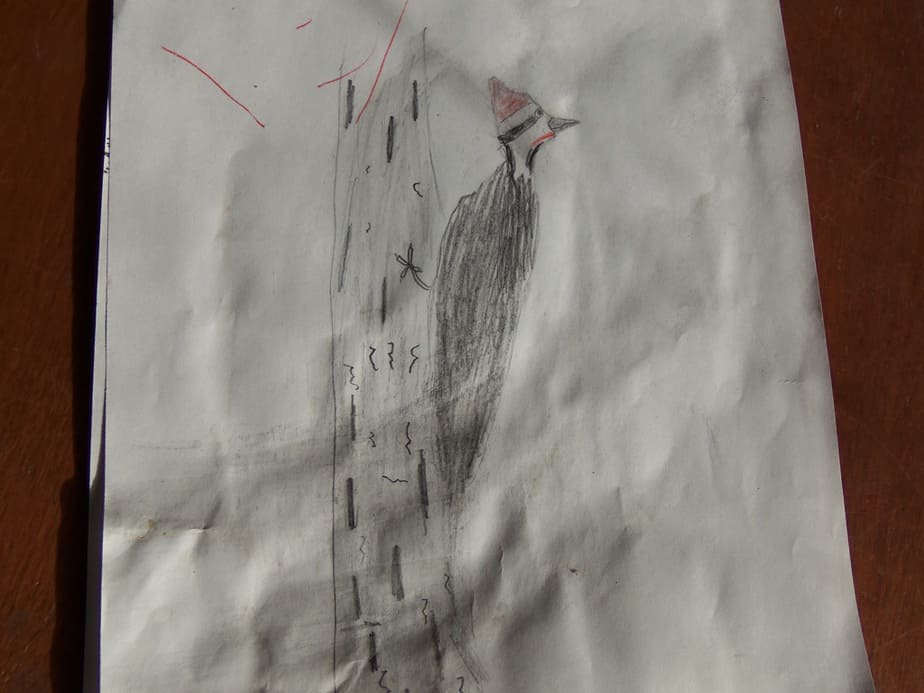
Just from the few units we have completed, I can see improvement in my daughters drawings. She has always enjoyed drawing, but has not been pleased with her end results. By learning techniques and tools incrementally, she is seeing how to achieve the results she wants. You can see one of her first drawings from these lessons compared to the woodpecker drawn above.

I also like the observation skills that are emphasized throughout the lessons. It seems especially at this age, our children are a bit unfocused, scattered. The observation skills practiced (I hope) can carry over into other subject areas.
We have used an ARTistic Pursuits book from the elementary series. Even with some experience and our natural love for drawing, this book has been a good fit. Though it starts with the very beginning fundamentals of art and drawing, it does not feel like remedial work. There are books for every age from preschoolers through high school.
The books are non-consumable so can be used for years by everyone in your family. I am looking forward to the second semester of lessons involving ink. I have not worked with ink washes or ink drawings since my own school days. Though I hope to join in, my daughter does not need my help. The lessons are laid out clearly — the assignment for each lesson is printed in a slightly different color (I would prefer this to be more distinct). My daughter is able to be fully independent in completing the lessons — and she really likes that.