

When I was a younger girl, I loved staring into the night sky and getting lost in the stars. The more I looked, the more I saw–especially when we lived in places that were “in the middle of no-where”. I always wished for a telescope, thinking I could truly be a stargazer if I had one.
I’ve learned one thing about stargazing over the years. You don’t need a telescope. The only thing you really need (maybe, some might argue with me over this) is some hot chocolate. Of course, getting outside and having little to no cloud cover helps too.
This time of year is my absolute favorite for watching the sky. Number one: it is easier to do without sacrificing sleep. You can step outside around dusk and watch the stars emerge as the sun’s light fades. Around here that is usually around 7–well before even our early bedtime. If you are early risers (like my crazy children–only crazy because I would prefer to sleep in), it is easy to catch some great celestial activities before the sun’s appearance. We are often out before 6 and have seen many meteors and other delights. Number two: my favorite constellation can only be seen during the cooler months.
Orion is my favorite constellation because it is the easiest one for me to find. It just jumps right out at you–no squinting or picture in a book necessary to figure it out. I love the red star that makes up the shoulder of Orion, too. It’s color is beautiful and it’s name is a fun one, Betelgeuse (pronounced beetlejuice).
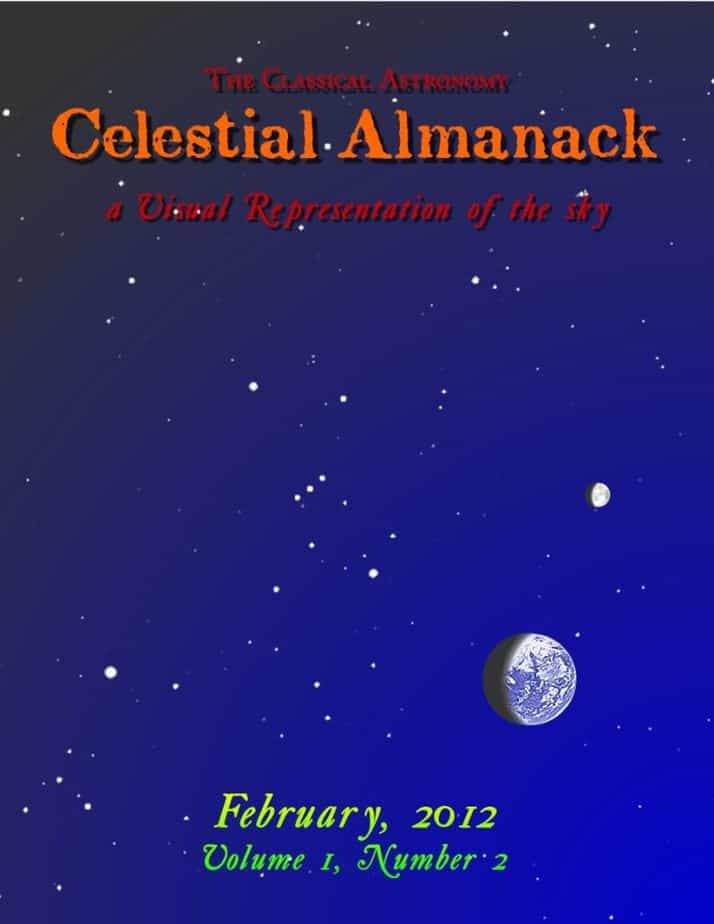
There are many more things going on in the night sky this month (and every month). To know what is what, and where and when to watch, you should check out the Celestial Almanack. This monthly e-publication from Classical Astronomy has all you need to know. Available through CurrClick for $3.00, you can even check out a preview of 5 pages of this 20+ page packed PDF.
Inside the Celestial Almanack, the illustrations are beautiful to look at and easy to understand. The names and other labels are clearly marked. The text is is not too difficult, though above the understanding of most younger children. As the month draws to a close, your child may ask “Why?” or “How?” in regards to leap day/year. Mr. Ryan has given a thorough explanation–complete with illustrations.
The Celestial Almanack is a great guide for family activities in night sky watching. Throughout the e-zine, there are many activities rated one star (easy) thru four star (difficult). They will have your family learning and enjoying the time outside. The Lord has given these things (sun, moon and stars) to us as signs and seasons. He means for us understand and be awed by them.
To learn more about astronomy from a Biblical perspective, check out other things from Classical Astronomy. Signs and Seasons, a homeschool curriculum and Moonfinder, a gorgeous picture book about the moon’s phases are just two of the things you will find.

To read more reviews by other Crew members, check out the Crew blog.