
We have been time travelers recently. We’ve immersed ourselves in the early nineteenth century. Our absolute favorite way to cover history is by combining historical fiction audio books and hands-on history resources. Home School in the Woods makes the most engaging and beautiful history resources we have seen. Their resources have been a constant in many of our learning adventures. We have been adding their ala carte items to our United States history studies, so it was an easy decision to choose one of the Time Travelers American History studies for this review. Time Travelers: The Early 19th Century fits perfectly with where (or is that when?) we are.
We schedule our history studies using a block schedule. We do one term of history, the next term science and alternate. Sometimes we do a few history blocks followed by a few science blocks. Science is a good fit for warmer months while history fits best for us during the cooler (and indoor) months. Nothing is better than listening to an audio book covering our history era while working on related history projects while a fire crackles in the woodstove. These are our favorite school memories. Hands-on learning fits our multi-age family-learning style. Hands-on projects range from lap books and interactive notebooks to physical projects or replicas like the coon-skin cap included in our study (no animal skin required 😉 ). Timelines, games, and recipes further add to the many projects you can choose from.
Choosing and completing the projects is just one way that Home School in the Woods products are flexible. You can spend as much or as little time you wish. There is a planning page that has each lesson’s components laid out. We often spend a couple of days per lesson as we add in biographies and videos when we have them or borrow them from the library. A couple of the older girls really enjoy the coloring and intricate cutting that some of the projects use. Our 12-year-old son loves putting together the various elements. None of these children will tell you they like doing lap books. But that is exactly what many of these neat, interactive booklets are for. We may just mount them to cardstock and put in the binder rather than putting together a lap book base. We’ll take a vote when we get there. I really appreciate how the instructions have us to complete the related item, then put it in a ziplock until we finish the whole study. This hides the lap book factor and keeps my middle children (who feel they are too old for lap books) more interested.
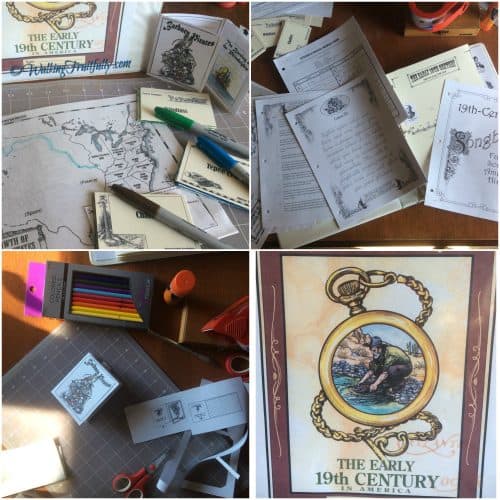
We have also been utilizing the copywork. The selections are taken from the rules of the McGuffey Eclectic Third Reader. We have a variety of pages to choose from for writing the passages. We use them all for the various age and abilities we have. They are all copying from the cursive page printed. Some are using their own notebooks, the younger children are either tracing or using one of the lined pages. We print these pages as we need them. Many of the other pages we printed several lessons worth at once. We keep all of the various elements in our 3-ring binder, a section for those ready for use in the back.
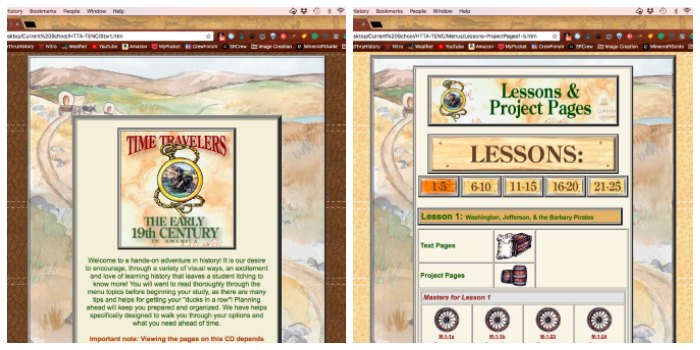
When you utilize the built-in menu or starting place it makes it easy to see what pages and masters need to be printed for each lesson. Some of the masters are used for more than one lesson, such as the page for the mapwork with all the various trails. The mapwork project in this study has been the neatest we have ever done. As the land is explored and territories are added, we add more via overlays to the original map. It is really neat to see how the country grew at that time. Whether using the download or the CD, you can also go directly to the pdfs and print from there. We try to minimize printing and have found the method of working through the menu allows us to read from the screen the text and instruction that don’t always need to be printed. Some projects can be a little complex, so we print those instructions on an as needed basis.
Not only do we have beautiful elements to work with in the booklets and in our notebook timeline, but the text for each lesson is excellent. You can tell that much time and research has been put into covering the details and the big picture. The expected information, as well as things unusual or noteworthy, is covered. I enjoy reading aloud so I often do the reading, but the level is such that any of my children reading at 6th-grade level could read this aloud or for themselves. But who wants to do this alone? The fun that we have and the memories that we make are not to be missed. To say nothing of what we will remember of the lessons because of the ways we have covered them.
Home School in the Woods has covered many eras of history – including the recently released Ancient Rome from the Project Passport series (you save when getting them all in one bundle – this could be two years of history!). You can use any of these complete studies as an overview of the era, as a spine for a longer study or do a series of two or three over the course of a school year.

